Styling
How to make a builder-grade home look custom
Five simple upgrades that make a standard room feel more elevated and intentional - without replacing everything.
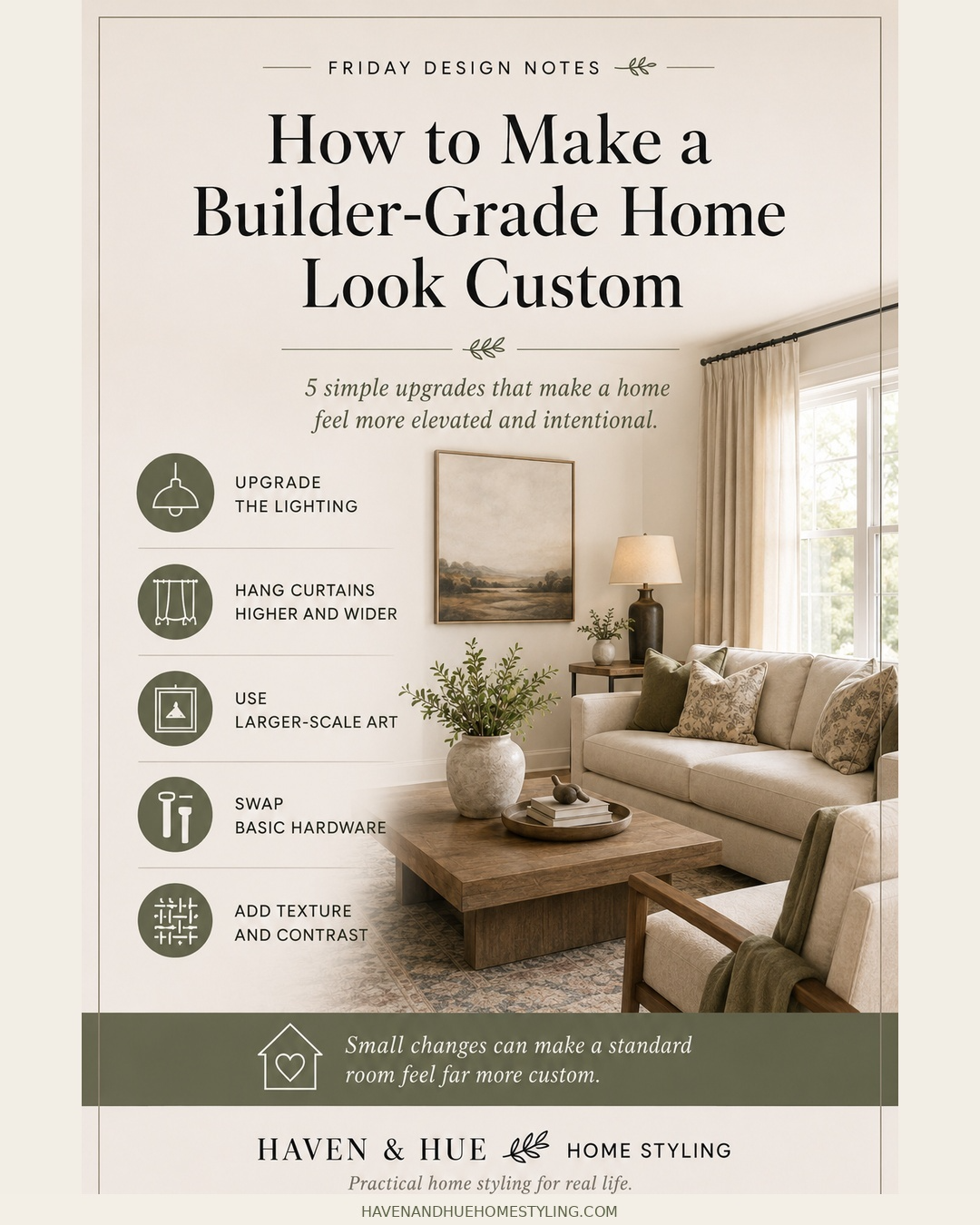
A home does not have to be fully renovated or filled with expensive finishes to feel personal and thoughtfully designed.
Many homes begin with standard builder selections. These choices are usually practical, neutral, and intended to appeal to a wide range of homeowners. They provide a clean starting point, but they can sometimes leave a room feeling generic or incomplete.
The good news is that you do not have to replace everything.
A few carefully chosen updates can add character, improve balance, and make the home feel far more intentional. The key is to focus on details that influence the entire room rather than adding more small decorative pieces.
Here are five places to begin.
1. Upgrade the lighting. Lighting has a major effect on how a room looks and feels. A standard ceiling light may provide enough brightness, but it does not always add warmth or personality. Replacing one prominent light, or adding a well-scaled table or floor lamp, can immediately change the atmosphere.
Consider the room at night, not only during the day. Does all the light come from one overhead source? Are some corners dark while other areas are overly bright? Does the room feel comfortable, or simply illuminated?
A more considered lighting plan often includes light at different heights. A ceiling light provides general brightness, while lamps create warmth and help define smaller areas within the room. You do not need to replace every light at once. Start with the fixture or lamp that is most visible.
2. Hang curtains higher and wider. Window treatments can influence the perceived size and proportion of an entire room. When a curtain rod is installed directly above the window and ends close to the outer frame, the window can appear smaller than it really is. Hanging the rod higher and extending it beyond the sides of the window creates a more generous appearance.
This also allows the curtains to sit beside more of the glass when they are open, which can help the room feel lighter. The curtains should look substantial enough for the window and should reach the floor cleanly. Fabric that stops at an awkward height can make the treatment feel unfinished. Even a simple curtain can look far more custom when it is positioned well.
3. Use artwork with enough scale. Artwork is often one of the first places where a room loses balance. A small piece placed on a large wall can look isolated, even when the artwork itself is attractive. A collection of several small pieces may also feel busy if the arrangement does not have enough overall presence.
One larger piece can create a stronger focal point and make the room feel calmer. When choosing artwork, consider the furniture beneath it. The artwork should feel visually connected to the sofa, console, bed, or cabinet rather than floating independently on the wall. The goal is not simply to fill an empty area. It is to create a relationship between the wall and the rest of the room.
4. Replace a few basic hardware details. Small hardware changes can have a larger impact than people expect. Cabinet handles, door hardware, and other frequently used fittings contribute to the overall impression of a home. When every piece is purely functional, the room may feel standard even after it has been decorated.
Replacing selected hardware gives you an opportunity to repeat a finish that already exists elsewhere in the room. For example, hardware might connect with the finish on a lamp, artwork frame, side table, or curtain rod. That repetition helps the room feel cohesive. You do not need to mix several statement finishes. A simple, consistent choice usually looks more considered.
5. Add texture and contrast. Many builder-grade rooms begin with smooth walls, simple flooring, plain cabinetry, and neutral finishes. That creates a useful foundation, but it can also make the room feel flat if every surface has a similar appearance.
Texture introduces depth. You might add it through curtains or woven window treatments, a substantial rug, cushions with different fabric finishes, wood or ceramic accessories, baskets or woven materials, greenery or branches, a textured throw, or one darker piece that provides contrast.
Contrast does not have to be dramatic. A dark frame, lamp, table, or decorative object may be enough to anchor a room filled with light neutrals. The aim is to give the eye different surfaces and tones to notice without making the room feel crowded.
Where should you start? Stand at the entrance to the room and look at it as a whole. Ask yourself: What is the first thing I notice? Which feature looks the most standard? Does the room have a clear focal point? Is the lighting warm and layered? Does the artwork suit the scale of the wall? Do the curtains make the windows look larger or smaller? Is there enough texture and contrast?
Choose one area rather than trying to update the entire room at once. A new light, better-positioned curtains, larger artwork, updated hardware, or added texture may be enough to change the overall impression.
A custom-looking home is not necessarily a home where everything has been replaced. It is a home where the details feel deliberate, connected, and personal. Small changes can make a standard room feel far more custom.